


Industrial Engineering · Floating Roof Tanks · Seal Technology
Compression Plate Seal for Floating Roof Tanks: Design, Benefits and Selection
Industrial storage tanks must accommodate changing liquid levels while limiting vapor losses and maintaining reliable operating conditions. In floating roof tanks, one of the main engineering challenges is sealing the space between the moving roof and the stationary tank wall.
A compression plate seal is one of the technologies used to address this challenge. Typically installed as part of a secondary rim sealing system, it combines flexible metallic plates with sealing elements designed to maintain contact with the tank shell as the floating roof moves.
For petroleum terminals, refineries and industrial storage operators, understanding how compression plate seals work is important when selecting equipment, planning retrofits or evaluating evaporation-control measures.
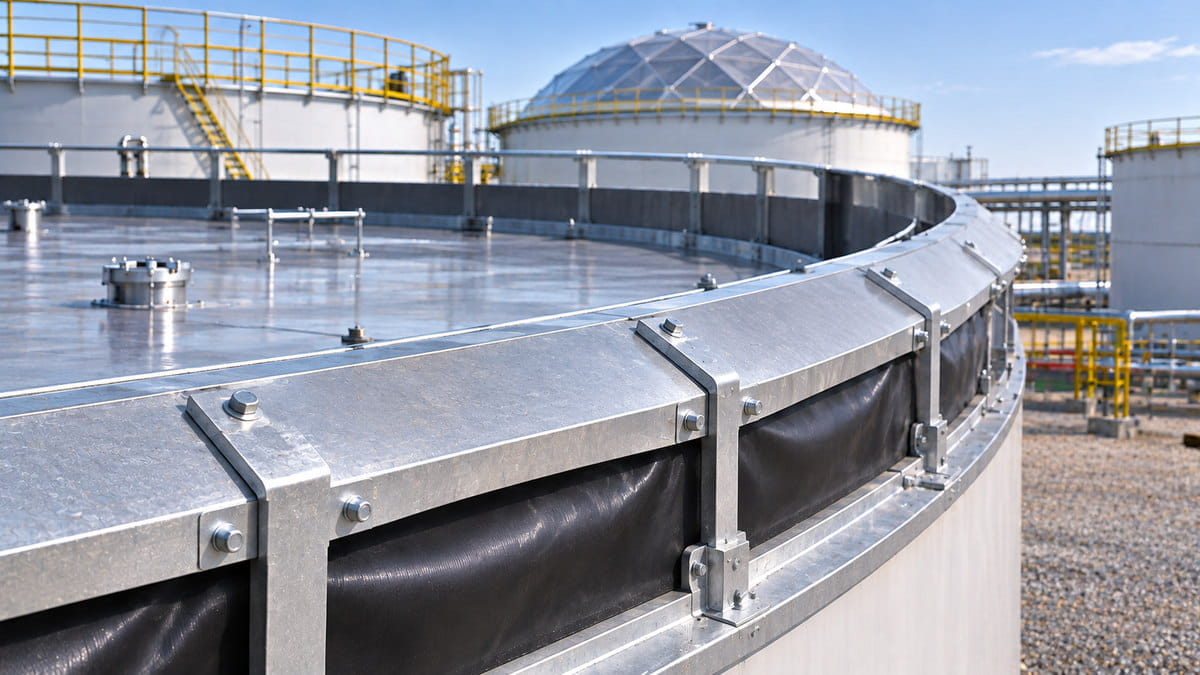
What is a compression plate seal?
A compression plate seal is a floating roof tank sealing system that uses flexible metallic plates to apply pressure against the tank wall, usually through a sealing tip or wiper.
It is commonly installed as a secondary rim seal above the primary seal to limit vapor movement through the annular space.
Its performance depends on plate flexibility, sealing materials, tank geometry, shell contact and proper maintenance.
What Is a Compression Plate Seal?
A compression plate seal is an engineered system that uses flexible metallic plates to apply pressure against the tank wall, usually through a sealing tip or wiper, helping reduce vapor movement through the annular rim space.
The annular rim space is the clearance between the perimeter of a floating roof and the cylindrical shell of a storage tank.
This clearance is necessary because the roof rises and falls as liquid enters or leaves the tank.
Without a suitable sealing arrangement, the gap can become a path for hydrocarbon vapor losses.
Compression plate systems are commonly used as secondary seals, positioned above the primary rim seal to provide an additional barrier.
Their effectiveness depends on the system design, the condition of the tank shell and the ability of the sealing components to remain in contact throughout normal roof movement.
How Does a Compression Plate Seal Work?
The operating principle is based on controlled mechanical flexibility.
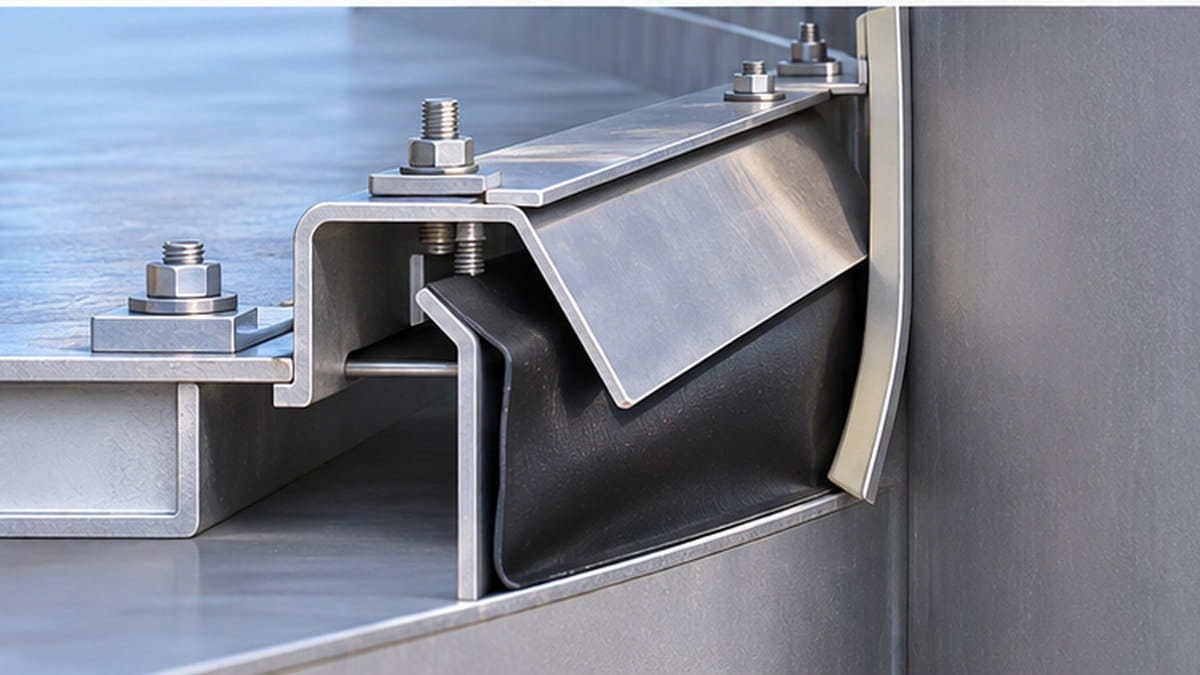
A series of metallic plates forms a continuous assembly around the floating roof perimeter. Their geometry allows them to deflect as the distance between the roof edge and the tank shell changes.
Flexible Metallic Compression Plates
The plates provide the force needed to press the sealing components toward the tank wall.
As the roof moves, changes in the annular gap cause the plates to flex.
This flexibility helps the assembly accommodate variations in clearance without preventing the roof from moving vertically.
The design must balance contact force and flexibility. Excessive resistance can increase wear or interfere with roof movement, while insufficient contact may leave gaps through which vapors can escape.
Sealing Tips and Wiper Elements
Many compression plate assemblies incorporate a flexible wiper or sealing tip where the system contacts the tank wall.
The wiper helps maintain a contact barrier while accommodating minor surface variations.
Depending on the design, its material may need to resist abrasion, weather exposure and the chemicals associated with the stored product.
A seal with damaged or deteriorated contact elements may lose effectiveness even when its metallic structure remains intact.
Vapor Barrier Membranes
Certain compression plate systems also use vapor barrier membranes to restrict vapor movement through the sealing assembly.
These flexible materials connect parts of the seal and help maintain continuity around the floating roof.
They must be selected according to chemical compatibility, permeability, mechanical resistance and expected operating conditions.
The metallic plates, flexible contact elements and vapor barrier should therefore be evaluated as parts of one engineered system.
Why Are Compression Plate Seals Used on Floating Roof Tanks?
Floating roofs are designed to reduce the vapor space above stored liquids.
However, the moving roof cannot be rigidly attached to the tank shell. The resulting annular gap needs a sealing arrangement that accommodates movement.
Primary and Secondary Rim Sealing
The primary seal provides the first barrier between the floating roof and the shell.
A secondary seal is installed above it to provide additional control of vapor movement.
A compression plate seal can form part of this secondary arrangement.
According to guidance published by the US Environmental Protection Agency, secondary seals can help reduce evaporation losses from floating roof tanks.
The effectiveness of a secondary seal depends partly on its mounting configuration and the extent to which it covers the rim vapor space.
Rim-Mounted and Shoe-Mounted Secondary Seals
A rim-mounted secondary seal extends from the floating roof rim toward the tank shell.
A shoe-mounted secondary seal is supported by the mechanical shoe of the primary seal.
These arrangements do not provide identical coverage of the rim vapor space.
EPA technical documentation identifies rim-mounted secondary seals as particularly relevant when controlling vapor escape around mechanical shoe primary seals.
The appropriate design must nevertheless reflect the actual tank configuration and applicable regulatory requirements.
Reducing Volatile Organic Compound Emissions
Petroleum products and many industrial liquids can release volatile organic compounds, commonly known as VOCs.
These emissions may contribute to product losses and environmental impacts.
Properly designed and maintained rim seals can reduce one of the potential vapor-loss paths in a floating roof tank.
However, rim seals are not the only source of emissions. Deck fittings, roof penetrations and other components also require attention.
Technical Consideration: VOC Emission Control
A compression plate seal should be considered part of an overall emission-control strategy, not a guarantee of zero emissions.
Performance depends on the seal configuration, tank operating conditions, product characteristics and maintenance.
Where Are Compression Plate Seals Installed?
Compression plate sealing systems are particularly relevant to floating roof storage tanks handling crude oil, refined petroleum products and other compatible industrial liquids.
External Floating Roof Tanks
External floating roofs are directly exposed to weather conditions. Secondary compression plate seals can provide an additional sealing barrier above the primary system.
Internal Floating Roof Tanks
Internal floating roofs operate beneath a fixed roof or dome. Seal selection must account for available clearance, roof construction and structural obstructions.
External Floating Roof Tanks
External floating roof tanks operate with their floating decks exposed to the atmosphere.
Their sealing systems may experience wind, precipitation, sunlight, temperature variations and other environmental influences.
A secondary compression plate seal can provide an additional barrier above the primary seal.
For this application, engineers should evaluate weather resistance, contact pressure, material durability and the interaction between the seal and the tank shell.
Internal Floating Roof Tanks
Internal floating roofs operate beneath a fixed roof or dome.
This arrangement changes the environmental conditions surrounding the floating deck.
Depending on the roof construction and available clearance, compression-based sealing technologies may also be considered for internal floating roof applications.
However, the design must account for limited space, roof supports, structural obstructions and the maximum operating liquid level.
The suitability of a particular system should not be assumed solely because it works on an external floating roof.
Compression Plate Seal vs Mechanical Shoe Seal: What Is the Difference?
Both technologies are used in floating roof tank sealing, but their functions and operating principles can differ.
Mechanical Shoe Seal
Typically uses metallic shoe plates held against the tank shell through a mechanical arrangement. It commonly serves as a primary sealing system.
Compression Plate Seal
Uses flexible metallic plates to maintain sealing pressure, often through a wiper or sealing tip. It is frequently used as a secondary seal.
Mechanical Shoe Seals
A mechanical shoe seal typically uses metallic shoe plates held against the tank shell by a mechanical arrangement.
A flexible vapor barrier connects the shoe assembly to the floating roof.
Mechanical shoe systems are widely used as primary seals.
Their purpose is to close the main annular gap while accommodating roof movement.
Compression Plate Seals
A compression plate system relies on the deflection of metallic plates to maintain sealing pressure.
In common secondary seal arrangements, these plates support a flexible contact element and may incorporate a vapor barrier membrane.
The compression plate system therefore complements the primary sealing arrangement rather than necessarily replacing it.
Some engineered primary seal configurations also use compression elements, so the role of each system must be identified from its actual design.
Which Technology Is More Appropriate?
There is no universal answer.
The selection depends on the tank geometry, stored product, operating environment, existing seal arrangement and applicable technical requirements.
For many projects, the decision is not between a mechanical shoe seal and a compression plate seal.
Instead, the engineering solution may involve a mechanical shoe primary seal combined with a compression plate secondary seal.
Key Engineering Factors When Selecting a Compression Plate Seal
The performance of a compression plate seal depends on several interconnected design considerations.
1. Annular Rim Space and Tank Geometry
The distance between the floating roof perimeter and the tank shell can vary around the circumference.
Tank roundness, shell irregularities and the condition of existing equipment can influence sealing performance.
The compression plates must accommodate the expected range of movement without losing contact or creating excessive mechanical resistance.
A dimensional survey is particularly important when selecting a system for an existing tank.
2. Compression Plate Material
Galvanized steel and stainless steel are common material options for industrial compression plate assemblies.
Selection should consider corrosion resistance, mechanical properties, operating temperatures and the tank environment.
The most appropriate material is not necessarily the same for every installation.
3. Chemical Compatibility of Sealing Elements
Stored liquids may contain compounds that affect elastomers, coated fabrics or other sealing materials.
Material selection should account for the actual product composition and service conditions.
Compatibility must be verified using appropriate technical documentation rather than assuming that a material is suitable for every petroleum or chemical product.
4. Continuity Around the Tank Perimeter
A seal must provide appropriate coverage around the circumference of the floating roof.
Connections, overlaps, fastening points and membrane joints are therefore important.
Poorly executed joints can undermine the performance of an otherwise suitable design.
5. Roof Travel and Mechanical Interference
The seal must accommodate the normal movement of the floating roof.
Its geometry should not interfere with fixed structures, shell attachments or other tank components throughout the operating range.
This is especially important when retrofitting a tank that was not originally designed for the proposed secondary seal.
Benefits of Compression Plate Sealing Systems
When properly selected and installed, compression plate seals can provide several operational benefits.
Main Operational Benefits
- Additional vapor control: a secondary sealing layer can reduce evaporation losses through the rim space.
- Adaptability: flexible metallic plates can accommodate changes in the annular gap.
- Compatibility with existing sealing arrangements: suitable systems may be integrated above established primary seals.
- Material options: metallic and flexible components can be selected according to service conditions.
- Maintenance planning: modular construction can support inspection and replacement strategies, depending on the design.
- Environmental management: improved rim sealing can contribute to broader VOC emission-control objectives.
These benefits depend on engineering suitability and the condition of the installation.
Actual performance should be assessed against the project's technical specifications and relevant environmental requirements.
Installing Compression Plate Seals on Existing Tanks
Many industrial tank projects involve improving existing equipment rather than constructing new facilities.
A compression plate seal retrofit may be considered when the existing rim sealing arrangement requires upgrading, repair or additional emission-control capability.
Initial Engineering Assessment
Before selecting a retrofit system, engineers should inspect the existing floating roof, rim construction, shell condition and available clearance.
The assessment should identify possible obstructions and evaluate whether the supporting structure can accommodate the proposed assembly.
Installation Planning
Installation methods depend on the seal design and the tank's operating status.
Some manufacturers offer configurations intended for in-service installation.
However, this capability must not be interpreted as permission to undertake work without proper isolation procedures, risk assessment, permits and facility-specific safety controls.
The operating conditions and applicable regulations determine whether installation can proceed safely.
Post-Installation Verification
After installation, the assembly should be checked for correct positioning, appropriate contact with the shell and compatibility with normal roof travel.
Fasteners, joints, vapor barriers and sealing tips also require inspection.
The acceptance criteria should follow the manufacturer's documentation and the applicable engineering specification.
How to Inspect and Maintain a Compression Plate Seal
Compression plate seals are exposed to mechanical movement and, depending on their location, environmental and chemical stress.
Inspection helps identify deterioration before it develops into a larger operational problem.
Important Inspection Points
- Contact with the tank shell: identify visible gaps or areas where contact has been lost.
- Plate condition: examine metallic elements for distortion, corrosion or mechanical damage.
- Flexible sealing tips: check for wear, cracking, hardening or displacement.
- Vapor barrier membranes: look for tears, deterioration and damaged connections.
- Fasteners and supports: verify that the components remain properly secured.
- Roof movement: assess whether the system is creating interference or abnormal wear.
Inspection frequency must reflect site conditions, regulations and equipment specifications.
Warning Signs of Reduced Performance
Potential indications of sealing problems include persistent gaps, damaged flexible elements, abnormal wear patterns and deformation of the compression plates.
Maintenance findings should be evaluated alongside the tank's broader integrity and environmental management program.
The presence of a secondary seal does not remove the need to inspect the primary seal or other potential vapor-loss paths.

TAC Enviro Compression Plate Seal Solutions
Selecting compression plate technology often requires several configurations to accommodate different storage tank dimensions and service conditions.
TAC Enviro, a Spanish industrial engineering company based in Seville, develops equipment for petroleum, petrochemical and industrial storage applications.
Its TankSeal product family includes primary and secondary sealing systems, along with several compression plate designs.
Compression Plate Configurations in the TankSeal Range
TAC Enviro identifies the following secondary compression plate configurations:
- CPL5: L-profile compression plate arrangement.
- CPP: P-profile compression plate arrangement.
- CPI: I-profile compression plate arrangement.
- CPU: U-profile compression plate arrangement.
- DL5: double compression plate configuration.
The different profiles provide engineering options for adapting the sealing arrangement to project specifications.
Their suitability must be evaluated according to the existing primary seal, rim geometry, tank shell and stored product.
Materials and Construction
According to TAC Enviro's published product information, its compression plate range uses galvanized or stainless-steel construction.
The broader secondary seal offering includes reinforced metallic components and vapor barrier materials such as PTFE-based products and polyurethane.
Individual material combinations should be confirmed for the selected seal model.
TAC Enviro also references API 650 in its product documentation. Compliance for a particular project must be checked against the applicable standard, edition, design specification and supporting documentation.
Engineering Beyond the Seal
The company also develops aluminum floating roofs and aluminum geodesic domes for industrial storage tanks.
These technologies address related but distinct requirements.
A floating roof helps limit the exposed liquid surface, a rim sealing arrangement reduces vapor movement around the roof perimeter, and an aluminum dome provides a fixed overhead enclosure.
For projects involving multiple technologies, compatibility must be considered at the overall tank-system level.
Compression Plate Seals and Long-Term Tank Performance
A compression plate seal is more than a metallic component fitted around the edge of a floating roof.
Its effectiveness depends on the interaction between the plates, flexible sealing materials, tank shell and floating roof movement.
For storage operators and engineering contractors, the principal considerations are compatibility, mechanical reliability, emission-control requirements and maintenance.
A suitable secondary sealing system can contribute to improved vapor containment, but it must be evaluated as part of the complete tank arrangement.
For organizations researching compression plate seal technology, the most useful next step is to compare available configurations against actual tank dimensions, product conditions and technical specifications.
TAC Enviro's TankSeal portfolio provides several compression plate options for engineering teams investigating industrial storage tank sealing solutions.
Explore TAC Enviro's Compression Plate Seal Solutions
Discover the TankSeal range of primary and secondary sealing systems for industrial floating roof tanks.
Learn more about compression plate configurations, sealing materials and equipment developed for different industrial storage applications.
Explore TAC Enviro TankSeal SystemsFrequently Asked Questions About Compression Plate Seals
What is a compression plate seal?
A compression plate seal is an engineered sealing arrangement that uses flexible metallic plates to maintain pressure against a storage tank wall, often through a wiper or sealing tip. It is commonly used as a secondary seal on floating roof tanks.
What is the purpose of a secondary compression plate seal?
Its purpose is to provide an additional barrier above the primary rim seal, helping reduce vapor movement through the annular gap between the floating roof and tank shell.
Can a compression plate seal reduce VOC emissions?
A correctly designed and maintained compression plate seal can contribute to reduced vapor losses from the rim space. The actual effect depends on the overall sealing arrangement, tank conditions and operating environment.
Is a compression plate seal the same as a mechanical shoe seal?
No. A mechanical shoe seal generally uses metallic shoes held against the tank shell and is commonly used as a primary seal. A compression plate system uses flexible plates to apply contact pressure and is frequently used in secondary sealing applications.
What materials are used in compression plate seals?
Common materials include galvanized or stainless steel for metallic components and chemically compatible flexible materials for wipers or vapor barriers. The exact specification depends on the stored product and operating conditions.
Can a compression plate seal be installed while a tank is operating?
Some designs are intended for in-service installation, but feasibility depends on the tank, stored product, site procedures and applicable safety requirements. A project-specific engineering and safety assessment is essential.
Are compression plate seals suitable for all floating roof tanks?
No. Their suitability depends on roof construction, available rim clearance, shell condition, mechanical interference and service requirements. Different configurations are available for different applications.
How often should compression plate seals be inspected?
Inspection intervals depend on the applicable standards, local regulations, operating conditions and the facility's maintenance program. Operators should follow the relevant equipment and site-specific procedures.
Technical References
For technical information about evaporation losses and rim sealing systems, consult the US EPA AP-42 guidance on organic liquid storage tanks.
Information about industrial storage tank design standards is available from the American Petroleum Institute.
Technical note: This article is intended for general technical information. It is not an installation manual, a certified design specification or a regulatory compliance assessment. Engineering decisions involving industrial storage tanks must be made by qualified professionals using the applicable standards, equipment documentation and site-specific safety requirements.
