


Industrial Engineering · Aluminum Floating Roofs · Storage Tanks
Aluminum Floating Roofs for Storage Tanks: Types, Benefits and Engineering Considerations
Industrial storage tanks are essential to the petroleum, petrochemical and chemical industries. Their operation requires reliable systems for containing stored liquids, managing vapor emissions and maintaining equipment performance throughout changing operating conditions.
Among the technologies used in modern storage facilities, aluminum floating roofs provide a lightweight solution for reducing the exposed surface of stored liquids. Installed inside suitable storage tanks, these structures move with the liquid level and help limit evaporation losses.
However, not all aluminum floating roofs have the same design. Pontoon-type and full-contact systems use different flotation principles, and their suitability depends on tank geometry, stored product characteristics, structural requirements and environmental objectives.
For terminal operators and engineering contractors, understanding these differences is essential when selecting a new floating roof or upgrading an existing storage tank.
What are aluminum floating roofs and how do they work?
Aluminum floating roofs are lightweight internal decks used in industrial liquid storage tanks to help reduce evaporation losses.
They move with the stored liquid and use either buoyant pontoons that support a non-contact deck or full-contact panels that rest directly on the liquid surface.
Their performance depends on flotation design, material compatibility, rim seals, deck fittings and operating conditions.
What Are Aluminum Floating Roofs?
Aluminum floating roofs are lightweight structures designed to float on or above the surface of liquid stored inside industrial tanks. They move vertically with the product level and help reduce evaporation by limiting the exposed liquid surface.
These systems are commonly installed beneath a permanent fixed roof, forming what is known as an internal floating roof tank.
Their construction typically includes aluminum structural members, floating elements or buoyant panels, perimeter seals and components that accommodate normal tank operations.
Unlike a fixed roof, which remains stationary, the floating deck follows changes in the liquid level.
This limits the vapor space associated with the stored product and can reduce certain evaporation-related emissions.
How Does an Aluminum Internal Floating Roof Work?
When liquid enters the tank, the floating roof rises.
As the liquid is withdrawn, the roof descends.
The floating structure remains supported by the stored liquid through a system of buoyant components or panels designed to provide sufficient flotation.
A peripheral seal closes the clearance between the floating roof edge and the tank shell while allowing vertical movement.
Other components, including deck fittings, support legs and anti-rotation arrangements, help the roof accommodate operational requirements.
The complete system must be designed to operate safely across the expected range of liquid levels.
Why Is Aluminum Used?
Aluminum has a relatively low density compared with steel and offers favorable corrosion resistance in many applications.
This makes it suitable for lightweight structural arrangements where transport, assembly and load management are important.
However, aluminum is not universally compatible with every stored chemical or operating environment.
Alloy selection, structural design, temperature, potential corrosion and material interactions must be assessed for the specific installation.
Types of Aluminum Floating Roofs: Pontoon vs Full-Contact Systems
Two important categories of aluminum internal floating roofs are non-contact pontoon designs and full-contact floating decks.
Both move with the stored liquid, but their flotation arrangements differ.
Pontoon-Type Floating Roof
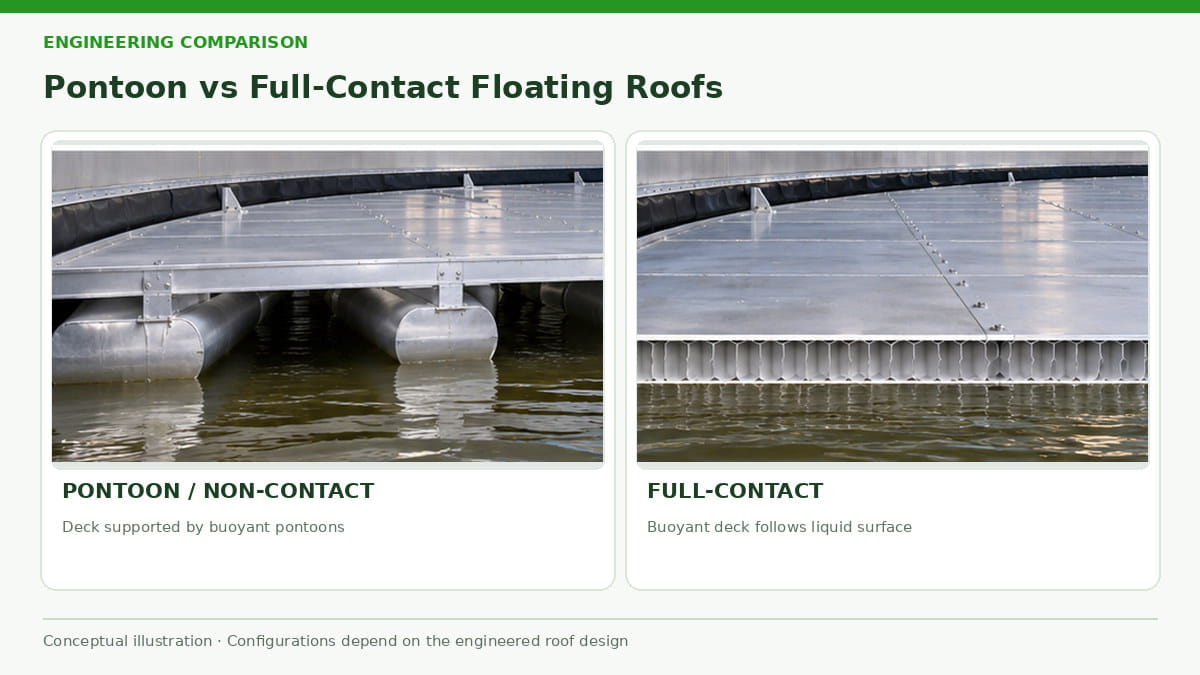
Uses buoyant pontoons beneath a lightweight aluminum deck. A small vapor space typically remains between the deck and the liquid surface.
Full-Contact Floating Roof
Uses buoyant panels designed to rest directly on the stored liquid, reducing the vapor space beneath the deck.
Pontoon-Type Aluminum Floating Roofs
A pontoon-type floating roof uses buoyant elements beneath a lightweight deck.
These pontoons support an interconnected structure of aluminum beams and panels.
Because the deck is supported above the liquid surface, a small vapor space typically remains underneath it.
This configuration is therefore described as a non-contact floating roof.
Pontoon systems are used in different petroleum and industrial storage applications.
Their design must account for flotation capacity, structural loading, joint integrity and the condition of the buoyant elements.
Full-Contact Aluminum Floating Roofs
A full-contact floating roof is designed so that its buoyant deck rests directly on the surface of the stored liquid.
Many full-contact designs use modular sandwich panels with internal buoyant cores, including honeycomb structures.
The panels provide flotation while forming a continuous deck across the liquid surface.
This arrangement reduces the vapor space directly beneath the deck compared with typical non-contact pontoon systems.
However, full contact does not mean that every emission pathway disappears. Rim seals, deck fittings and connections still require proper design and maintenance.
Which Design Is More Suitable?
The choice between pontoon and full-contact systems depends on the application.
A pontoon roof may be appropriate when the project requires a lightweight modular design with a particular structural arrangement.
A full-contact design may be considered when reducing the vapor space beneath the deck is an important engineering objective.
Neither system should be selected solely on the basis of its general category.
The assessment must consider stored product properties, buoyancy, operational requirements, material compatibility, inspection and the expected performance of the complete tank.
Main Components of an Aluminum Floating Roof
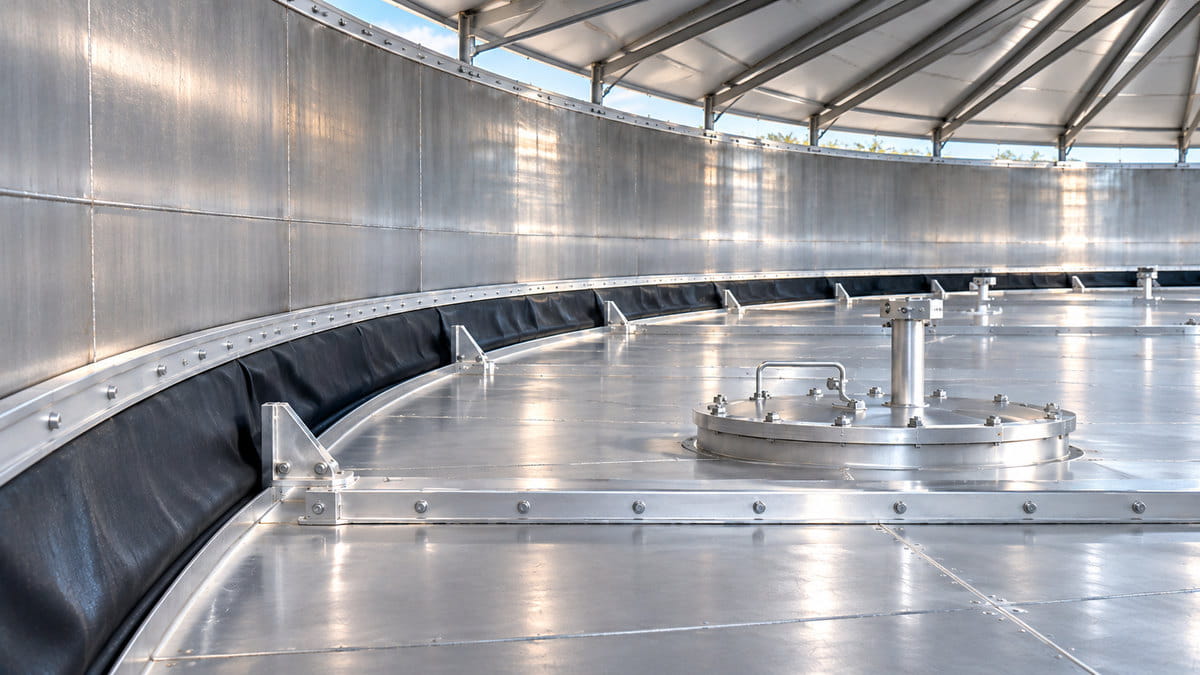
An aluminum floating roof consists of several interconnected components.
Their configuration varies according to the roof type and manufacturer.
Structural Framework and Deck Panels
Pontoon-type roofs generally use aluminum beams or profiles to support a deck.
The panels create a physical barrier above the stored liquid and connect to the supporting framework.
In full-contact systems, modular buoyant panels may provide both the deck surface and the flotation function.
Structural design must account for the expected operational loads and the required safety margins.
Pontoons and Flotation Elements
Pontoons are buoyant components used to support certain floating roof designs.
They must provide adequate flotation under the conditions specified for the tank.
Their construction should account for potential leakage, deformation, corrosion and inspection requirements.
In full-contact systems, individual buoyant panels or enclosed compartments can perform a similar supporting function.
Rim Sealing Systems
A floating roof cannot be rigidly connected to the tank wall because it must move vertically.
A clearance therefore exists around the roof perimeter.
Primary and, where required, secondary rim seals help limit vapor movement through this gap.
Their selection must be compatible with the floating roof geometry and stored product.
Deck Fittings and Access Components
Internal floating roofs incorporate fittings required for normal operation.
Depending on the design, these may include access openings, support legs, column penetrations, gauge-related equipment and other operational components.
Each fitting must be evaluated as part of the complete tank system.
Poorly maintained fittings can create additional vapor-loss pathways.
Benefits of Aluminum Floating Roofs for Industrial Storage
Properly engineered aluminum floating roofs can provide several benefits for suitable storage applications.
Reduced Evaporation Losses
By limiting the exposed liquid surface, the floating deck helps reduce vapor generation and release.
Lightweight Construction
Aluminum structural systems can provide a favorable strength-to-weight relationship for appropriate designs.
Modular Installation
Certain systems use components that can be transported and assembled within existing tanks.
Product Conservation
Lower evaporation losses can support efforts to reduce avoidable product loss.
Sealing Compatibility
Floating roof systems can incorporate appropriate primary and secondary rim seals.
Fixed Roof Integration
Aluminum floating roofs can operate beneath compatible fixed-roof structures, including geodesic domes.
Additional Operational Advantages
- Maintenance flexibility: some modular configurations allow individual components to be inspected or replaced, depending on the design.
- Application versatility: different flotation technologies provide options for particular storage requirements.
- Environmental management: improved vapor-loss control can contribute to broader facility objectives.
These benefits are not identical for every installation.
Actual performance depends on roof construction, stored product characteristics, installation quality and continued maintenance.
Aluminum Floating Roofs and VOC Emission Control
Volatile organic compounds, commonly known as VOCs, can evaporate from petroleum products and certain chemicals.
Controlling these emissions is an important consideration for storage terminal operators and environmental engineers.
An internal floating roof helps reduce the liquid surface exposed to the vapor space beneath a fixed roof.
How Do Floating Roofs Reduce Evaporation?
In a conventional fixed-roof tank without an internal floating deck, a vapor space exists above the liquid.
Changes in temperature, pressure and liquid level can contribute to vapor movement through the tank's ventilation system.
A floating roof reduces the exposed liquid surface and follows the product level, changing the mechanisms associated with evaporation.
This can reduce routine vapor losses.
The US Environmental Protection Agency describes these configurations and provides methodologies for estimating emissions from different storage tank types.
Emission Differences Between Pontoon and Full-Contact Roofs
Non-contact pontoon systems typically have a vapor space between the deck and the liquid surface.
Full-contact systems reduce this underlying space by placing the deck directly on the product.
However, the difference in total emissions cannot be determined from that distinction alone.
The roof's rim seal, deck seams, fittings and operating conditions can all influence the final result.
Emission performance must therefore be assessed for the actual configuration.
Why Rim Seals and Deck Fittings Still Matter
Even with an aluminum floating roof, vapor losses may occur around the deck perimeter.
Additional losses can arise from certain deck seams and fittings.
A suitable sealing system helps address these pathways.
The combination of the floating deck, rim seals and appropriately controlled fittings is therefore more important than considering the roof structure in isolation.
Can Aluminum Floating Roofs Eliminate VOC Emissions?
No.
A correctly selected floating roof can reduce relevant emission sources, but it does not guarantee zero emissions.
Normal operation, maintenance activities, roof landing events and other tank conditions may still generate vapor losses.
Facilities should use appropriate engineering assessments and recognized emission-estimation methodologies when evaluating environmental performance.
Important: Emission Performance
Aluminum floating roofs should not be treated as a guarantee of zero VOC emissions.
Overall emissions depend on the floating deck, rim seal, deck fittings, stored product and operating conditions.
Aluminum Floating Roofs vs Steel Floating Roofs
Aluminum and steel floating roof systems are used in different industrial applications.
Their suitability depends on tank design, environmental conditions and operational requirements.
Aluminum Floating Roof
Offers lightweight structural options, modular construction and corrosion resistance in suitable industrial environments.
Steel Floating Roof
May use different structural arrangements and construction methods, with material protection requirements depending on the application.
Structural Weight
Aluminum has a lower density than steel.
For a comparable application, this can make it possible to develop lightweight structural arrangements.
However, the final weight depends on the complete design, panel construction, structural members and required flotation capacity.
Corrosion and Material Selection
Aluminum can provide corrosion-resistance advantages in suitable environments.
Steel structures may require different corrosion-protection strategies.
Neither material is universally superior for every stored product.
Compatibility with chemicals, corrosion mechanisms and operating temperatures must be evaluated.
Installation and Maintenance
Modular aluminum systems can offer practical assembly options, particularly for suitable tank retrofit projects.
Steel floating roofs may use different construction and installation methods, including welded components.
The comparison should consider the actual roof designs, maintenance requirements, installation conditions and expected service life.
Which Material Should Be Selected?
The decision should result from a technical and economic assessment.
Relevant factors include structural capacity, product compatibility, tank geometry, environmental regulations and lifecycle requirements.
A material comparison alone is insufficient to determine the best floating roof.
Engineering Factors When Selecting Aluminum Floating Roofs
Selecting a floating roof requires accurate information about the tank and its service conditions.
1. Tank Diameter and Geometry
The roof must be designed for the dimensions and geometry of the storage tank.
Important considerations include tank diameter, shell roundness, internal columns and existing equipment.
Structural irregularities can affect available clearance and component positioning.
2. Stored Product and Chemical Compatibility
The stored liquid influences the selection of aluminum alloys, seals, joints and flotation components.
Specialty chemicals and certain petroleum products may require additional compatibility assessments.
Material specifications should be verified against the actual product composition and operating conditions.
3. Buoyancy and Structural Capacity
The roof must provide sufficient buoyancy for its intended service.
Engineering calculations should consider the required flotation performance, structural loading and potential failure conditions specified for the system.
The design must also account for relevant operational loads.
4. Contact or Non-Contact Configuration
Engineers should determine whether a pontoon-type or full-contact design better meets the project objectives.
This decision can influence structural design, vapor-space characteristics, inspection and maintenance arrangements.
It may also affect the selection of sealing systems and fittings.
5. Maximum Filling Level and Roof Travel
Internal floating roofs operate beneath fixed roofs.
The available vertical clearance must therefore be checked across the entire operating range.
Potential interference with roof rafters, support columns and other equipment must be addressed.
The maximum permitted filling level may be affected by the final roof configuration.
6. Applicable Standards and Regulations
API 650 Annex H provides requirements for internal floating roofs when this standard applies to the project.
Environmental requirements may also govern tank configuration, sealing arrangements and inspection.
The applicable standards and editions must be identified for each installation.
Reference to a standard does not automatically establish compliance for a particular roof.
Can Aluminum Floating Roofs Be Installed in Existing Tanks?
Aluminum floating roofs can be considered for both new construction and retrofit projects.
Installing an internal floating roof in an existing fixed-roof tank may improve vapor-loss management, provided the tank is suitable.
Initial Tank Assessment
The first stage involves reviewing the tank structure, dimensions and operating conditions.
Engineers should examine the shell, internal supports, existing roof configuration and available access.
Previous repairs or modifications may influence the feasibility of the project.
Installation Planning
Certain modular systems allow components to be brought into the tank through existing access openings.
This may reduce the need for some structural modifications, depending on the project.
However, storage tanks can contain flammable vapors and hazardous atmospheres.
Installation must follow appropriate isolation, atmospheric testing, access and work-permit requirements.
The possibility of assembly through a manway does not remove the need for a comprehensive safety assessment.
Integration with Existing Equipment
A new floating roof must be compatible with tank fittings, internal columns and operational equipment.
Rim sealing, roof supports and movement restrictions require particular attention.
The engineering assessment should also consider the fixed roof and ventilation arrangements.
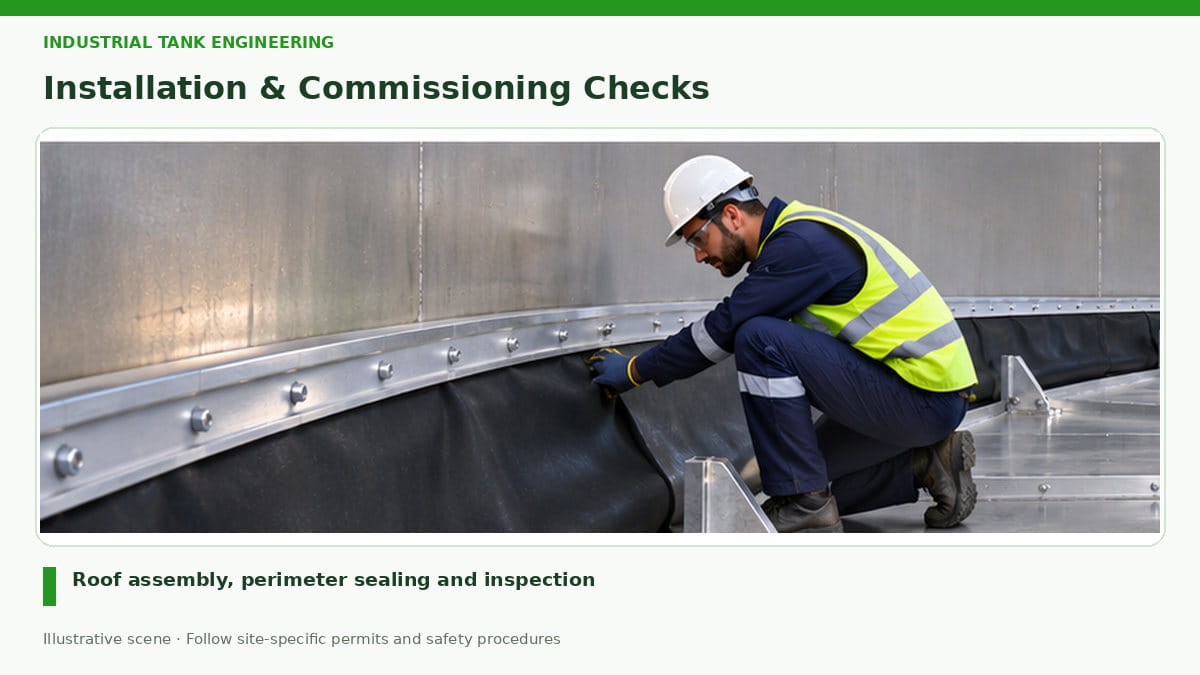
Commissioning and Verification
After installation, the floating roof should be checked against its design documentation.
Relevant inspections may include structural connections, flotation components, seals, fittings and roof movement.
The acceptance process must follow the applicable standard and manufacturer's requirements.
Aluminum Floating Roof Inspection and Maintenance
Floating roofs require ongoing inspection to maintain their intended performance.
Their condition may change because of mechanical movement, material deterioration and operating conditions.
Key Components to Inspect
A preventive maintenance program should consider:
- Pontoons or flotation panels: checking for damage, leakage or loss of integrity.
- Structural members: identifying deformation, cracking or unusual wear.
- Deck panels and joints: examining damage, loosened connections or deterioration.
- Rim seals: checking for gaps, wear and damaged flexible components.
- Deck fittings: assessing operational condition and the integrity of relevant seals.
- Support legs and attachments: inspecting their condition and compatibility with roof movement.
- Tank interfaces: checking for interference, corrosion or structural irregularities.
The inspection program should reflect applicable regulations, equipment specifications and the facility's operating procedures.
Roof Landing and Operational Events
A floating roof may rest on its supports when the liquid level falls below the minimum floating position.
This is known as roof landing.
Such events can affect vapor-space conditions and may contribute to additional emissions.
The operational implications should be considered when planning filling, emptying and maintenance activities.
Why Maintenance Is Essential
Damaged flotation elements, inadequate sealing or structural deterioration can compromise the performance of the roof.
Routine inspection helps identify these issues.
However, inspection inside industrial storage tanks must be carried out under appropriate safety controls, including confined-space procedures where applicable.
TAC Enviro Aluminum Floating Roof Solutions
Industrial storage projects require equipment that can be adapted to different tank dimensions, products and operating conditions.
TAC Enviro, a Spanish engineering company operating in the industrial storage sector, offers floating roof systems and complementary tank technologies.
Its product range includes TankPontoon and TankContact, two solutions based on different flotation concepts.
TankPontoon
Modular pontoon-type floating roof based on an interconnected structural grid and buoyant pontoons supporting the deck.
TankContact
Full-contact floating roof technology using modular buoyant panels designed to remain in contact with the stored liquid.
TankPontoon: Modular Pontoon-Type Floating Roof
TankPontoon is TAC Enviro's internal floating roof system based on an interconnected structural grid and buoyant pontoons.
According to the company's published information, the system is available in aluminum or stainless steel.
Its design includes floating pontoons without longitudinal welds and provides options for integration with primary and secondary sealing systems.
TAC Enviro describes the system as suitable for applications involving products sensitive to evaporation, including fuels and industrial chemicals.
The project-specific configuration must be selected according to the stored product and operating requirements.
TankContact: Full-Contact Floating Roof Technology
TankContact uses modular floating panels designed to remain in direct contact with the stored liquid.
This design is intended to reduce the vapor space beneath the floating deck.
TAC Enviro describes TankContact as an option for refined products, crude oil and specialty chemical applications, with modular construction intended to facilitate installation and inspection.
The panel materials, chemical compatibility and exact configuration should be confirmed against the technical documentation for the selected project.
Complementary Tank Technologies
TAC Enviro also develops aluminum geodesic domes and tank sealing systems.
These components perform complementary functions.
The floating roof reduces the exposed liquid surface, the rim seal addresses vapor movement through the annular clearance, and the fixed dome provides an overhead enclosure.
For projects involving multiple technologies, their compatibility must be verified as part of the complete storage tank design.
Further technical information is available in TankPontoon aluminum floating roof systems from TAC Enviro.
Choosing Aluminum Floating Roofs for Long-Term Storage Performance
Aluminum floating roofs offer engineering options for facilities seeking to improve product conservation and manage evaporation losses in suitable storage tanks.
Pontoon-type systems and full-contact decks use different flotation arrangements, each with its own design and maintenance considerations.
Selecting the most appropriate system requires an assessment of the stored product, tank geometry, buoyancy, structural compatibility, environmental requirements and operational conditions.
For industrial operators evaluating aluminum floating roofs, a project-specific engineering review is essential.
TAC Enviro's TankPontoon and TankContact product families provide different approaches to floating roof technology, allowing engineering teams to assess compatible options for new installations and selected retrofit projects.
Explore TAC Enviro's Aluminum Floating Roof Systems
Discover TAC Enviro's TankPontoon solutions for internal floating roof storage tanks.
Explore modular floating roof construction, flotation components and sealing configurations for different industrial storage applications.
Explore TAC Enviro TankPontoon SystemsFrequently Asked Questions About Aluminum Floating Roofs
What are aluminum floating roofs?
Aluminum floating roofs are lightweight structures installed inside suitable storage tanks. They float on or above the liquid surface, following changes in product level and helping reduce evaporation losses.
How do aluminum floating roofs work?
They use buoyant pontoons or floating panels to support a deck that rises and falls with the stored liquid. Rim seals and fittings help manage vapor movement through the perimeter and other openings.
What is the difference between pontoon and full-contact floating roofs?
Pontoon-type systems support a deck above the liquid surface using buoyant elements. Full-contact systems use floating panels that rest directly on the liquid, reducing the vapor space beneath the deck.
Can aluminum floating roofs reduce VOC emissions?
Properly designed floating roofs can reduce evaporative losses by limiting the exposed liquid surface. Their actual emissions depend on the complete roof configuration, rim seals, fittings and operating conditions.
Are aluminum floating roofs suitable for all storage tanks?
No. Their suitability depends on tank dimensions, structural condition, stored product compatibility, operating temperatures, access and applicable technical requirements.
Can aluminum floating roofs be installed in existing tanks?
Yes, suitable fixed-roof tanks may be candidates for retrofit installation. Engineering assessment is required to confirm structural compatibility, available clearance and installation feasibility.
What are the main components of an aluminum floating roof?
Common components include aluminum structural members, deck panels, pontoons or buoyant modules, rim seals, supports and operational fittings.
Do aluminum floating roofs require maintenance?
Yes. Flotation components, deck joints, rim seals, structural elements and fittings require appropriate inspection and maintenance.
Can aluminum floating roofs be combined with geodesic domes?
Yes. An internal floating roof can operate beneath a compatible fixed geodesic dome. The two systems have different functions and must be evaluated together.
Which standards apply to aluminum floating roofs?
API 650 Annex H is a relevant reference for internal floating roof design where applicable. Other environmental, inspection and safety requirements may also apply.
Technical References
Further information about evaporative losses and internal floating roof storage tanks is available in the US EPA AP-42 guidance on organic liquid storage tanks.
For industrial storage tank design standards, including internal floating roof requirements, consult publications issued by the American Petroleum Institute.
Technical note: This article provides general engineering information and does not constitute a certified design specification, installation procedure or regulatory compliance determination. Floating roof selection, installation and maintenance must be evaluated by qualified professionals following applicable standards, manufacturer documentation and site-specific safety requirements.
